Kamran is on his motorcycle in the middle of Tajrish Square. Behrooz calls him:
Behrooz: Where are you?
Kamran: Tajrish Square.
Behrooz: Good, come straight at 50 kilometers per hour — you’ll get there in less than fifteen minutes. Of course, don’t run red lights, and don’t drive on the sidewalk!
Kamran: I promise to respect the traffic rules. 🫡An hour later, Behrooz calls again, his nerves frayed:
Behrooz: Do you have any idea where you are? If you had walked, you would have arrived by now!
Kamran: Well, I’m going 70 instead of 50, but I’m still not getting there… Wait, let me check how much further I have to go…
A few moments later:
Kamran: Behrooz, I’m near Lavasan. They told me I took a wrong turn! 😬
Behrooz: Idiot! Which way did you go?
Kamran: You said straight, so I went straight! 🤷
Behrooz: What can I say to you… Listen carefully, Seyedkhandan is south of Tajrish. Now head west — the direction where the sun sets — for the same amount of time at the same speed. When you reach Tajrish Square, turn south and come straight to Seyedkhandan.
Kamran: Okay, okay, I got it.
Behrooz: No, no, forget it. Just sit in a corner of the café there, and I’ll come to you on my motorcycle. Via the highway, it’ll take about an hour. 😤
So, what happened here? 🤔
Behrooz told Kamran to “come straight at 50 kilometers per hour.” Kamran did go straight, but instead of heading south, he went east and ended up in Lavasan. Everything fell apart.
I think when Behrooz finally reached Kamran, he was thinking about shoving Kamran’s motorcycle handlebars… into Kamran’s throat — but honestly, Kamran is the main culprit here! 😅
Lesson 1: In everyday life, whenever we talk about “speed” in the city, we mean speed — not physical velocity. Look at your car’s speedometer — it says “80”. Well, 80 kilometers per hour, but in which direction? So, if one person is driving from east to west on the highway and another from west to east, do their speedometers show different values? No! Both show 80. Because this device is showing speed, not direction. It’s called a “speedometer,” but it should really be a “speed gauge”! 😄
Lesson 2: In physics, what matters more is velocity — meaning “how fast and in which direction.” If Behrooz had said “move at a speed of 50 kilometers per hour towards the south” instead of “come straight,” everything would have worked out correctly.
So, we’ve understood the difference between speed (which has no direction) and velocity (which has direction).
Now look — temperature is the same. We say “the room temperature is 25 degrees Celsius.” Someone asks, “Towards the southwest?” 😄 Does it even matter? No, temperature has no direction. Or for example, length: “This stick is one meter long” — does this one meter have a direction? No, it doesn’t.
Simple criterion 🎯: Whenever you want to see if a quantity is a vector or not, see if “which way?” is a meaningful question. If yes — it’s a vector. If it seems silly — it’s a scalar.
A note — don’t confuse length with displacement ⚠️
Just as we confuse speed and velocity, we might also confuse length and displacement:
- “The distance from Jajrud to Seyedkhandan is 10 kilometers” — here we are talking about length (distance), a scalar quantity. Is Seyedkhandan south of Jajrud or east? It doesn’t matter at all, only “how far it is” matters.
- “Kamran moved from Jajrud to Seyedkhandan by motorcycle” — here we have displacement, a vector quantity. It means he moved from north to south — direction matters!
Another example: “Behrouz’s height is 165 centimeters” (length — scalar) is different from “Behrouz moved 10 meters to the south” (displacement — vector).
First things first: What is a quantity? 📏
Remember when we said physics is an experimental science based on measurement? Well, in physics, anything that can be measured is called a physical quantity. For example: length, mass, speed, force, the time it takes for an object to fall — they are all quantities.
And here is a golden rule you should never forget 🚨:
Stating a physical quantity without mentioning its unit is meaningless!
If I say “My mass is 65”… 65 what? Kilograms? Grams? Tons? 😅 A number alone is meaningless. You must say “65 kilograms.” It’s always number + unit. Think of it like bread and cheese; they don’t go apart 🧀.
Now, we have two families of quantities 👨👩👧👦
Family One: Scalar Quantities
These are quantities that are fully defined by a number and its unit. That’s it! They don’t need a direction.
For example? When you say “This person’s height is 168 centimeters” or “Their mass is 65 kilograms,” everything is clear. Height doesn’t have a “direction”! 😄 A number and a unit are enough.
Other scalar examples: mass, length, time, temperature, energy, speed.
Family Two: Vector Quantities
These are a bit more demanding 😏. In addition to a number and a unit, they also need a direction; otherwise, they are incomplete.
For example? “This cyclist’s displacement is 25 meters, towards the north.” Here, if you only say “25 meters,” it’s unclear where they went. Direction is an inseparable part of its meaning.
Vector examples: displacement, velocity, acceleration, force. (You had a basic introduction to these in 9th-grade science 👌)
And the second golden rule 🚨:
Stating a vector quantity without its magnitude and direction is meaningless!
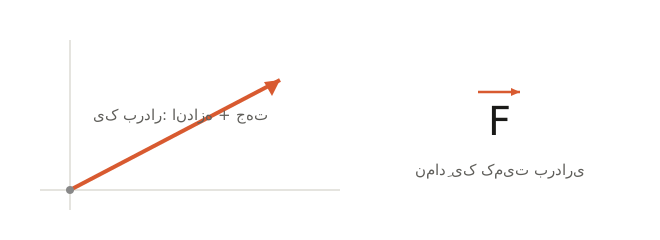
> 🎮 **Try it yourself:** Drag the tip of the vector and watch how its “magnitude” and “direction” change simultaneously. A vector quantity is exactly that — a number alone cannot fully define it.
Speed vs. Velocity 📌
The physics summary:
Speed: Just “how fast?” — a scalar quantity. Always positive.
Velocity: “How fast and in which direction?” — a vector quantity. It can be negative (if moving in the opposite direction).
Classic example 🚗: You drive a full lap around a track and return to the start. Average speed = a positive number, but average velocity = zero! Because the total displacement is zero (you ended up at the same point) 🤯.
How Do We Represent Vectors? ➡️
Physicists indicate that a quantity is a vector by placing a small arrow above its symbol:
[ vec{F} quad vec{a} ]
That small arrow above the letter means “remember, this has a direction!” For example, ( vec{F} ) means force (with direction), and ( vec{a} ) means acceleration (with direction).
But if we write the same letter without the arrow — for example, just ( F ) or ( a ) — then we are referring only to the magnitude of that quantity (i.e., the number and its unit, without direction). So that little arrow is very important; don’t leave it out casually 😄.
One last note: Vectors have their own specific rules for addition and multiplication (you can’t just add them like regular numbers!). For example, if you walk 3 steps east and 4 steps north, your total displacement is not 7 steps — it’s 5 steps in a diagonal direction! 📐 You will learn about this in detail in later chapters.
Informal Summary 🎁
Ask yourself two questions to determine whether a quantity is scalar or vector: 1. Can it be fully described by just a “number and unit”? → Scalar ✅ 2. Or must you also specify a “direction”? → Vector ➡️
These two questions are the whole story. Next time you hear the name of a quantity, run this test on it 😎.
“Did You Know?” Box 💡
The word “scalar” comes from the Latin root scala, meaning “ladder” or “scale” 🪜 — because these quantities fit only on a numerical scale, like the rungs of a ladder. And “vector” comes from vehere, meaning “to carry” — because a vector seems to “carry” something from one point to another (both magnitude and direction). Their names are not arbitrary at all! 🤓
Test Yourself 📝
Click on each question to reveal the answer 👇
* * *
Analysis with Python 🐍
Vector Addition — See the Difference Between Scalar and Vector! ➡️
We said that if you go 3 steps east and 4 steps north, the total displacement is not 7 steps — it’s 5 steps. Let’s have Python draw this for us:
import numpy as np
import matplotlib.pyplot as plt

fig, axes = plt.subplots(1, 2, figsize=(11, 4.5))

# ── Scalar: total distance traveled ────────────────────────────
ax = axes[0]
steps = [3, 4]
labels = ['3 stepsnEast', '4 stepsnNorth']
colors = ['#3498db', '#e74c3c']
x = 0
for s, l, c in zip(steps, labels, colors):
    ax.barh(0, s, left=x, height=0.4, color=c, alpha=0.8)
    ax.text(x + s/2, 0, l, ha='center', va='center', fontsize=9, color='white', fontweight='bold')
    x += s
ax.barh(0, sum(steps), height=0.4, color='none', edgecolor='green', linewidth=2, linestyle='--')
ax.text(sum(steps)/2, -0.35, f'Distance = {sum(steps)} steps', ha='center', fontsize=10, color='green', fontweight='bold')
ax.set_xlim(0, 8); ax.set_ylim(-0.8, 0.8); ax.set_yticks([])
ax.set_title('Scalar quantity (distance)nSimple numerical addition', fontweight='bold')
ax.set_xlabel('Steps')

# ── Vector: actual displacement ─────────────────────────────────
ax = axes[1]
v1 = np.array([3, 0])   # East
v2 = np.array([0, 4])   # North
result = v1 + v2

def arrow(ax, start, end, color, label):
    ax.annotate('', xy=end, xytext=start,
                arrowprops=dict(arrowstyle='->', color=color, lw=2.5))
    mid = (start + end) / 2
    offset = np.array([-0.3, 0.2])
    ax.text(*(mid + offset), label, color=color, fontsize=9, fontweight='bold')

arrow(ax, np.array([0,0]), v1, '#3498db', '3 East')
arrow(ax, v1, v1+v2, '#e74c3c', '4 North')
arrow(ax, np.array([0,0]), result, '#27ae60', f'Result={np.linalg.norm(result):.0f}')
ax.scatter(*result, s=100, color='#27ae60', zorder=5)
ax.set_xlim(-0.5, 4.5); ax.set_ylim(-0.5, 5)
ax.axhline(0, color='gray', lw=0.5); ax.axvline(0, color='gray', lw=0.5)
ax.set_aspect('equal')
ax.set_title('Vector quantity (displacement)nPythagorean theorem: sqrt(3²+4²)=5', fontweight='bold')
ax.set_xlabel('East (steps)'); ax.set_ylabel('North (steps)')
ax.grid(alpha=0.3)

plt.suptitle('Scalar vs Vector — adding 3 and 4', fontsize=13, fontweight='bold')
plt.tight_layout()
plt.savefig('vector_vs_scalar.png', dpi=120, bbox_inches='tight')
plt.show()
💡 Note: Change
v1to[3, 3]— the displacement angle changes, but the Pythagorean theorem still works!
Resources and Further Reading 📚
Wikipedia
Video — YouTube 🎬
- Khan Academy: Intro to vectors and scalars
- MinutePhysics: Vectors and 2D motion
- 3Blue1Brown: Vectors — what even are they?
Video — Aparat 🎬
Simulator
On this site 🔗
In the next section, we’ll dive into one of the most important agreements in the history of science: the International System of Units (SI) — why the whole world agreed on the “meter” and the “kilogram,” and how these standards were created 🌍. See you there! 👋
Have a question? 🤔
If something isn't clear or you have a question, ask it here. The answer will be published on this page.
💬 جواب بهتری داری؟ یا یه سؤال جدید؟
اگه به سؤالای بالا پاسخی داری که فکر میکنی روشنتر یا کاملتر از مال منه، یا یه سؤال جدید برای دانشآموزای دیگه داری — تو بخش نظرات پایین صفحه ارسال کن. هر پیامی رو میخونم، تأیید میکنم و منتشر میشه. اینجوری همه از تجربهی همدیگه استفاده میکنیم. 🌱