From Article 1: Newton had the form of the gravity law (F = GMm/r²) but not the number G, and so did not have the absolute mass of the Earth or Sun. There was only one way past this deadlock: measure the gravitational force between two known masses, directly in the laboratory.
The problem: this force is extremely small. For two 1-kg spheres 1 m apart:
\[ F = G\,\frac{Mm}{r^2} \approx 6.67 \times 10^{-11}\ \mathrm{N} \]
About the weight of a single red blood cell. How do you tease such a force out of friction, air currents, ground vibration, and stray electrostatic charge?
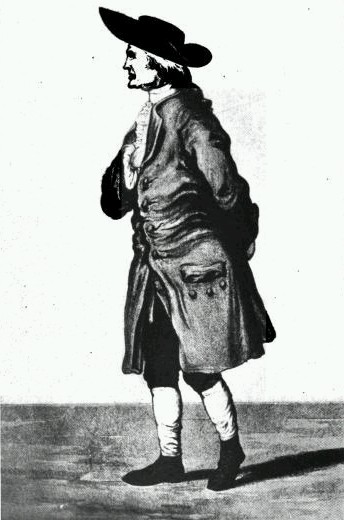
Henry Cavendish's 1798 answer: the torsion balance — a device of remarkable cleverness.
The core idea: twist a wire, don't push a scale
To weigh a 10⁻¹⁰ N force on an ordinary scale, that scale would need better-than-impossible precision. Cavendish sidestepped this: instead of sensing the force directly, he let it twist a thin wire, and measured the angle of twist instead.
Even a very small twist of a thin wire produces a restoring torque — and if you pick the wire thin enough, that resistance is very small. So even a very weak force gives an observable angle.
Cavendish's apparatus
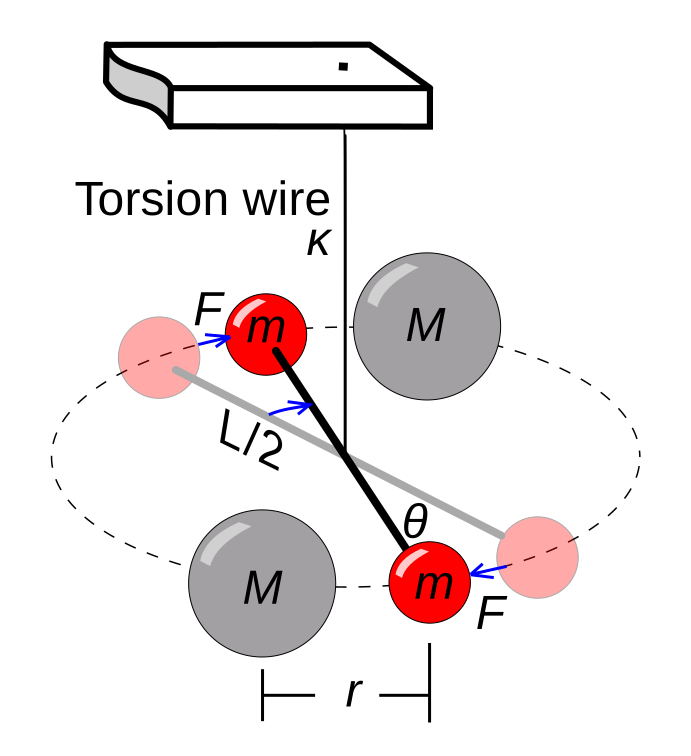
Main structure:
- A horizontal wooden rod of length
L ≈ 1.83 m(six feet), suspended at its center by a thin silver wire about a meter long. - Two small lead spheres of mass
m ≈ 0.73 kgeach, at the ends of the rod. - Two large lead spheres of mass
M ≈ 158 kgeach, positioned by an external lever system at a known distancer ≈ 0.23 mfrom the small spheres. - A small mirror on the rod, reflecting the light of a candle onto a distant wall — any tiny rotation of the rod tilted the mirror and moved the light spot centimeters across the wall (optical amplification!).
- A large wooden case enclosing the whole rig, to eliminate air currents. Cavendish observed the mirror through a telescope from outside the case (so his body heat wouldn't disturb the air).
The entire experiment was housed in a shed in his garden, operated remotely. Individual measurements took hours.
The math: from twist to G
Step 1 — the torsion law (Hooke's law for rotation)
Every torsion wire obeys Hooke's law: restoring torque is proportional to twist angle:
\[ \tau_\text{wire} = -\kappa\, \theta \]
where κ is the torsion constant of the wire (a property of material and dimensions).
Step 2 — equilibrium: gravity twists the wire
When the large spheres are placed near the small ones, each exerts a gravitational force F = GMm/r². These two forces (one on each end of the rod) create a torque that rotates the rod:
\[ \tau_\text{grav} = 2 \cdot F \cdot (L/2) = F L = \frac{G M m L}{r^2} \]
At equilibrium, gravitational torque equals wire restoring torque:
\[ \frac{G M m L}{r^2} = \kappa\, \theta \]
Solve for G:
\[ G = \frac{\kappa\, \theta\, r^2}{M m L} \]
Everything on the right is measurable: M, m, L, r with meter and scale; θ from the shift of the light spot on the wall. The one unknown: κ, the torsion constant. How to get it?
Step 3 — κ from the oscillation period
If you flick the rod (with the large spheres removed), it oscillates about its axis — like a pendulum, but with the wire's twist-resistance as the restoring effect. This is a torsion pendulum.
For a torsion pendulum:
\[ T_\text{oscillation} = 2\pi \sqrt{\frac{I}{\kappa}} \]
with I the moment of inertia of the system (rod + spheres):
\[ I = 2 m (L/2)^2 = \frac{m L^2}{2} \]
(assuming a light rod and point spheres — a useful approximation with small error)
Hence:
\[ \kappa = \frac{4\pi^2 I}{T^2} = \frac{2 \pi^2 m L^2}{T^2} \]
Step 4 — the final formula
Substitute κ into the G equation:
\[ G = \frac{\theta\, r^2}{M m L} \cdot \frac{2\pi^2 m L^2}{T^2} = \frac{2 \pi^2\, \theta\, r^2\, L}{M\, T^2} \]
The beautiful result:
\[ \boxed{G = \frac{2 \pi^2\, \theta\, r^2\, L}{M\, T^2}} \]
- The small sphere mass
mcancels out! (It appeared in both the gravitational torque and the moment of inertia.) - All variables are ordinary measurements:
θan angle (optical),randLlengths (ruler),Ma mass (scale),Ta time (clock). - We got G without ever referring to the Earth. Two lab objects only.
Numerical example
Using Cavendish's approximate figures:
M = 158 kg,L = 1.83 m,r = 0.23 mθ ≈ 3 × 10⁻³ rad(tiny twist — optical amplification made this a4 mmdisplacement on the wall)T ≈ 7 minutes = 420 s(long period, because the wire is very compliant)
\[ G \approx \frac{2 \pi^2 \cdot (3 \times 10^{-3}) \cdot (0.23)^2 \cdot 1.83}{158 \cdot (420)^2} \approx 2 \times 10^{-10} \]
(Cavendish's actual precision was better than this back-of-envelope estimate — the calculation above just shows the order of magnitude.) His final result:
\[ G_\text{Cavendish} \approx 6.74 \times 10^{-11}\ \mathrm{N \cdot m^2 / kg^2} \]
Less than 1% off the modern value 6.674 × 10⁻¹¹ — a spectacular achievement for 1798.
Why did Cavendish call his paper "the Density of the Earth"?
The paper's original title was "Experiments to Determine the Density of the Earth" — not "measuring G". Why?
Because in the framing of his era, the meaningful result was: we can now compute the density of the Earth. Once G is known:
\[ M_E = \frac{g R_E^2}{G} \quad\Rightarrow\quad \rho_E = \frac{M_E}{(4/3)\pi R_E^3} = \frac{3g}{4\pi R_E G} \]
With g = 9.8, R_E = 6.37 × 10⁶ m, G = 6.7 × 10⁻¹¹:
\[ \rho_E \approx \frac{3 \cdot 9.8}{4\pi \cdot 6.37 \times 10^6 \cdot 6.7 \times 10^{-11}} \approx 5500\ \mathrm{kg/m^3} \]
About 5.5× the density of water — or about twice the density of surface rock. So the Earth's core must be made of much denser material (metal, probably iron) — a fundamental geological insight that emerged from a physics experiment.
From today's view, G is the fundamental achievement — a universal constant; M_E is one multiplication away. But from Cavendish's view, in an era when "the density of the Earth" was a mystery, he had solved that mystery.
Modern precision — why G is still problematic
Since 1798, laboratories have re-measured G with ever-better technology. Today:
\[ G = 6.67430(15) \times 10^{-11}\ \mathrm{N \cdot m^2 / kg^2} \]
where (15) is uncertainty on the last two digits. Only 3 significant figures — the worst-known fundamental constant:
c = 299,792,458 m/s— exacth = 6.62607015 × 10⁻³⁴ J·s— exactk_B = 1.380649 × 10⁻²³ J/K— exactG = 6.6743 × 10⁻¹¹ ± 0.0001— 3 digits!
Why? The same problem Cavendish faced:
- Gravity is weak. Even with multi-ton spheres, force is nano-newton scale.
- Gravity cannot be shielded. Unlike electric forces, which can be shut out by a Faraday cage, gravity passes through everything. A bus on the nearby road perturbs the signal.
- Sensitive to everything. Temperature, humidity, static charge, vibration, even ocean tides.
Different labs report values that differ by up to 0.05%. We still don't know G to better than ~3 ppm.
What you should be able to do
After this article, you should be able to:
- Explain the core idea of the torsion balance: why twist angle (not direct force) is measured
- Derive the G formula from Hooke's law for rotation (
τ = κθ) and the torsion pendulum (T = 2π√(I/κ)) - Explain why the small-sphere mass
mdisappears from the finalG = 2π²θr²L/(MT²) - Understand why Cavendish's paper was titled "Density of the Earth"
- State why G is still the least-precisely-known fundamental constant
Preview of Article 3
Now we have both the law (Newton) and the number G (Cavendish). Time to harvest: in Article 3 we'll compute Earth's mass, derive the numerical value of g from universal gravitation, and see how g varies with altitude. Along the way, we'll see why mgh (the high-school potential energy formula) works only for small heights, and why satellites need the full U = -GMm/r.
📚 Primary source: Henry Cavendish, Experiments to determine the Density of the Earth, Philosophical Transactions of the Royal Society of London, 88, 469-526 (1798). 📖 Open reference: OpenStax University Physics Vol 1 — §13.1: Newton's Law of Universal Gravitation. 📖 Modern review: G. Rosi et al., Precision measurement of the Newtonian gravitational constant using cold atoms, Nature 510, 518-521 (2014).
Have a question? 🤔
If something isn't clear or you have a question, ask it here. The answer will be published on this page.