
12. Dotted line trick
Problem Description & Analysis
Official Problem Statement
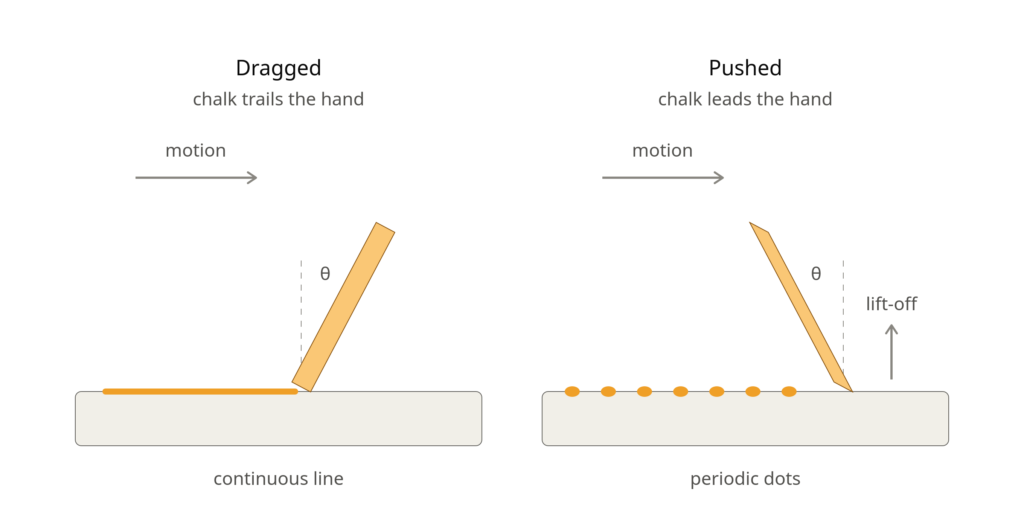
“Under certain conditions, when a piece of chalk is dragged across a blackboard, the resulting trace is not a continuous line but a periodic sequence of dots, even though the motion is uninterrupted. This can happen with other writing materials and surfaces. Investigate the physical parameters that govern this phenomenon.”
The Stick-Slip Mechanism
Rather than sliding uniformly, chalk on a blackboard undergoes stick-slip oscillation. The root cause is the velocity-weakening friction force (the Stribeck effect): static friction $f_s$ exceeds kinetic friction $f_k$, and $f_k$ decreases with increasing sliding speed. This creates a negative-damping regime that makes uniform sliding unstable.
Simple model: chalk (effective mass $m$, effective stiffness $k_{\rm eff}$) is dragged at constant hand speed $v_0$.
Stick phase: chalk is in contact with the board, elastic load builds up:
$$m\ddot{x} + k_{\rm eff}(x – v_0 t) = 0$$
When the elastic force reaches $f_s$, chalk suddenly slips.
Slip phase: chalk detaches or lifts slightly from the surface (friction drops to $f_k \ll f_s$), executes free vibration, and leaves no mark:
$$m\ddot{x} + k_{\rm eff}(x – v_0 t) = -f_k \cdot \text{sgn}(\dot{x} – v_0)$$
The oscillation frequency during stick-slip is:
$$f_{\rm osc} \approx \frac{1}{2\pi}\sqrt{\frac{k_{\rm eff}}{m}}$$
Dot Spacing and Governing Parameters
The oscillation period is $T = 1/f_{\rm osc}$. In each period the chalk advances by $d_{\rm dot}$:
$$\boxed{d_{\rm dot} = v_0 \cdot T = \frac{v_0}{f_{\rm osc}} = \frac{2\pi v_0}{\sqrt{k_{\rm eff}/m}}}$$
The dot spacing is therefore proportional to the dragging speed $v_0$ and inversely proportional to the square root of the effective stiffness $k_{\rm eff}$.
Critical Speed
Below a critical dragging speed $v_c$, stick-slip does not develop and the chalk leaves a continuous line. The critical speed follows from the stability condition of the equilibrium sliding state:
$$v_c \approx \sqrt{\frac{k_{\rm eff}}{m}} \cdot \frac{f_s – f_k}{(\partial f/\partial v)\big|_{v=0}}$$
Above $v_c$, the stick-slip cycle becomes self-sustaining (a stable limit cycle in the phase plane), analogous to Helmholtz motion of a bowed string or squealing brakes.
Effective Stiffness
The effective stiffness $k_{\rm eff}$ combines the chalk’s own stiffness, the flexural stiffness of the hand and arm, and the contact stiffness of the surface:
$$\frac{1}{k_{\rm eff}} = \frac{1}{k_{\rm chalk}} + \frac{1}{k_{\rm arm}} + \frac{1}{k_{\rm contact}}$$
Parameters
$\theta$ — chalk inclination angle relative to board: smaller angle → larger $k_{\rm eff}$ → smaller $d_{\rm dot}$
$F_N$ — normal pressing force (N): affects both $f_s$ and $f_k$
$k_{\rm eff}$ — effective stiffness (N/m): sets the oscillation frequency
$m$ — effective mass of chalk and hand/arm (g): larger $m$ lowers frequency and increases dot spacing
Surface roughness — $R_a$ (μm): shapes the friction-velocity curve
Experimental Setup
To measure $d_{\rm dot}$ as a function of $v_0$ and $\theta$:
- Mount chalk on a linear rail driven by a stepper motor at precisely controlled speeds.
- Scan or photograph the resulting trace and measure dot spacing by image processing.
- Plot $d_{\rm dot}$ versus $v_0$ — expect a linear relationship with slope $1/f_{\rm osc}$.
- Repeat at different inclination angles $\theta$ and with added masses to vary $m$ independently.
- Attach a small accelerometer to the chalk to directly measure $f_{\rm osc}$ and compare to $\sqrt{k_{\rm eff}/m}/(2\pi)$.
References
- Rabinowicz, E., Friction and Wear of Materials, 2nd ed., Wiley, 1995 — Velocity-dependent friction.
- Leine, R. I., van Campen, D. H., de Kraker, A., “Stick-Slip Vibrations Induced by Alternate Friction Models,” Nonlinear Dynamics 16 (1998) 41–54.
- Akay, A., “Acoustics of friction,” J. Acoust. Soc. Am. 111 (2002) 1525–1548.
- Stoimenov, B. L. et al., “The roughness effect on the frequency of frictional sound,” Tribol. Int. 40 (2007) 659–664.
Related Images
Suggested Resources
Questions & Discussion
You must be an IYPT member and logged in to view or ask questions.
Log In