
13. Vortex pendulum
Problem Description & Analysis
Official Problem Statement
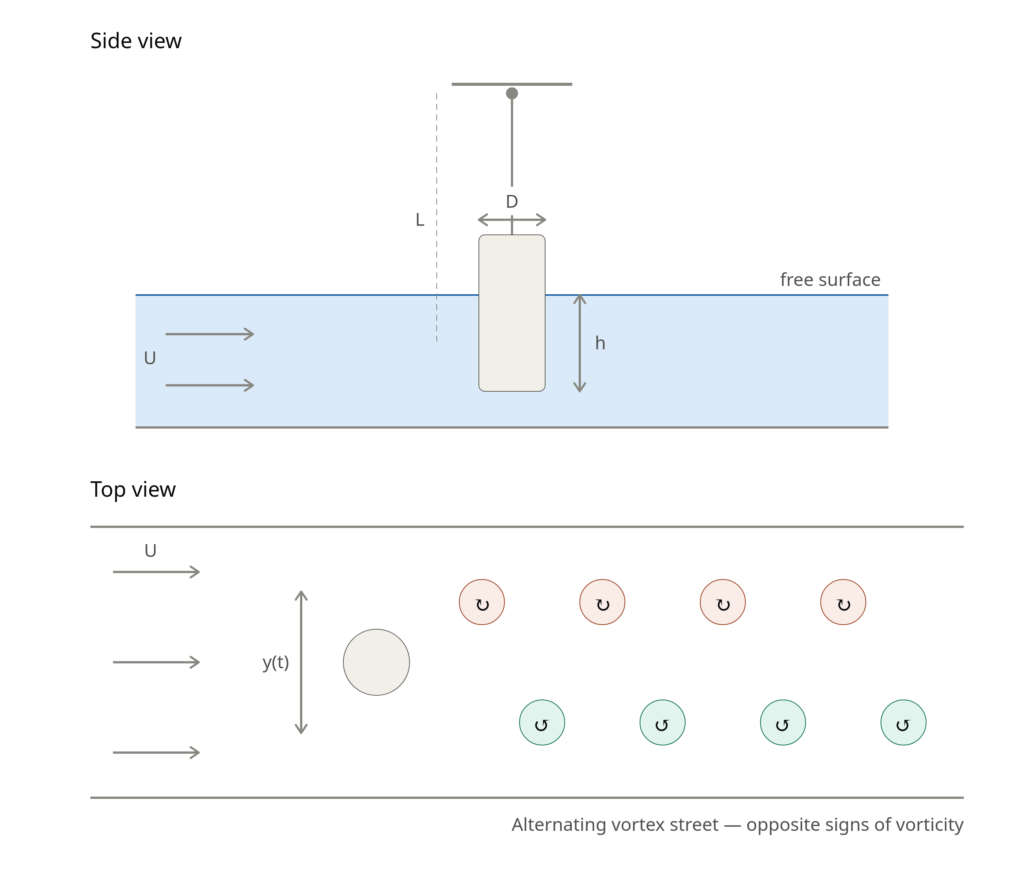
“A pendulum with a vertically oriented cylindrical bob is suspended above a channel of flowing water. When the bob is partially submerged, the flow may cause the pendulum to oscillate in a direction perpendicular to the flow. Explain this phenomenon and determine how it depends on relevant parameters.”
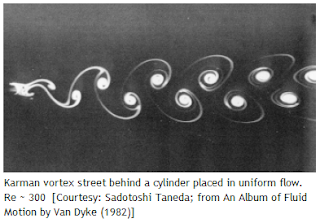
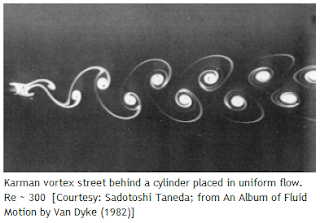
Karman Vortex Street and Transverse Force
A flow at speed $U$ past a circular cylinder of diameter $D$ sheds vortices alternately from each side in a Karman vortex street. The shedding frequency is set by the Strouhal number $St$:
$$\boxed{f_s = \frac{St \cdot U}{D}},\qquad St \approx 0.20\quad \text{for}\quad Re = 10^3 \text{–} 10^5$$
where $Re = UD/\nu$ is the Reynolds number and $\nu$ is the kinematic viscosity of water. The alternating vortex shedding produces an oscillating transverse (lift) force on the cylinder:
$$F_L(t) = \frac{1}{2}\rho U^2 D L_{\rm sub}\, C_L\,\sin(2\pi f_s t)$$
where $\rho$ is the water density, $L_{\rm sub}$ is the submerged length of the cylinder, and $C_L \approx 0.3$–$0.5$ is the lift coefficient.
Vortex-Induced Vibration (VIV) and Lock-in
The natural frequency of the pendulum (neglecting hydrodynamic effects) for a pendulum of length $L$:
$$f_n = \frac{1}{2\pi}\sqrt{\frac{g}{L}}$$
When $f_s \approx f_n$, the transverse force drives the pendulum into resonance, producing large lateral oscillations. This is vortex-induced vibration (VIV).
The key non-dimensional parameter is the reduced velocity:
$$U_r = \frac{U}{f_n \cdot D}$$
Lock-in: over the range $U_r \approx 5$–$8$, the vortex shedding frequency synchronizes with the pendulum’s oscillation frequency even as the flow speed changes. The oscillation amplitude is maximized within the lock-in band:
$$A_{\max} \approx \frac{C_L\,\rho\, U^2\, D\, L_{\rm sub}}{2\,(2\pi f_n)^2\, m_{\rm eff}\, \zeta}$$
where $m_{\rm eff}$ is the effective pendulum mass and $\zeta$ is the damping ratio. Outside lock-in, the pendulum amplitude drops sharply and the shedding frequency reverts to $St \cdot U/D$.
Parameters
$D$ — cylinder diameter (cm): $f_s \propto 1/D$; larger $D$ shifts lock-in to lower $U$
$L$ — pendulum length (cm): $f_n \propto 1/\sqrt{L}$; determines at which $U$ lock-in occurs
$L_{\rm sub}$ — submersion depth of cylinder (cm): lift force $F_L \propto L_{\rm sub}$
$Re = UD/\nu$ — Reynolds number: affects $St$ and $C_L$
$U_r = U/(f_n D)$ — reduced velocity: the criterion for lock-in ($U_r \approx 5$–$8$)
Experimental Setup
To measure transverse oscillation amplitude as a function of $U$ and $D$:
- Build a water channel with adjustable flow speed (pump with control valve and flow meter).
- Suspend the cylindrical pendulum over the channel. Keep the submersion depth fixed.
- Increase flow speed from zero upward; record the transverse oscillation amplitude with a camera or potentiometer.
- Plot $A/D$ versus $U_r$ — a clear peak near $U_r \approx 5$–$8$ should appear.
- Repeat for several pendulum lengths $L$ (different $f_n$) to verify the dependence on $U_r$.
- To determine $St$, measure the shedding frequency with a hot-wire or pressure sensor at flow speeds outside the lock-in range.
References
- Blevins, R. D., Flow-Induced Vibration, 2nd ed., Van Nostrand Reinhold, 1990 — Chapter on cylinder VIV.
- Williamson, C. H. K., Govardhan, R., “Vortex-Induced Vibrations,” Annu. Rev. Fluid Mech. 36 (2004) 413–455.
- Sarpkaya, T., “A critical review of the intrinsic nature of vortex-induced vibrations,” J. Fluids Struct. 19 (2004) 389–447.
- Zdravkovich, M. M., Flow Around Circular Cylinders, Vol. 1, Oxford, 1997.
Related Images
Suggested Resources
- 🔗 Vortex Dynamics — HyperPhysics (GSU)
- 🔗 Pendulum Dynamics — MIT OCW 8.01
- 🔗 Fluid Vortex — PhET Simulation
- 📖 Williamson, C.H.K. & Govardhan, R. (2004). Vortex-induced vibrations. Annu. Rev. Fluid Mech. 36, 413–455.
- 📖 Sarpkaya, T. (2004). A critical review of the intrinsic nature of vortex-induced vibrations. J. Fluids Struct. 19(4), 389–447
- 📖 Blevins, R.D. Flow-Induced Vibration
- 📖 Sumer, B.M. & Fredsøe, J. Hydrodynamics Around Cylindrical Structures
- 📖 «Experiments on vortex-induced vibration of a vertical cylindrical structure: effect of low aspect ratio
- 📖 Large-amplitude flow-induced vibration of cylindrical pendulums» — J. Fluids Struct. (2018
- 📖 «A review on vortex-induced vibrations in confined flows» — Ocean Engineering (2023).
- 📖 Gonçalves, R.T. & Fujarra, A.L.C. (2014). Experimental study on VIV of floating circular cylinders with low aspect ratio. ASME OMAE.
- 📖 Facchinetti, de Langre & Biolley (2004). Coupled wake oscillator models for VIV
- 📖 «Piezoelectric energy extraction from a cylinder undergoing VIV using internal resonance»
Questions & Discussion
You must be an IYPT member and logged in to view or ask questions.
Log In