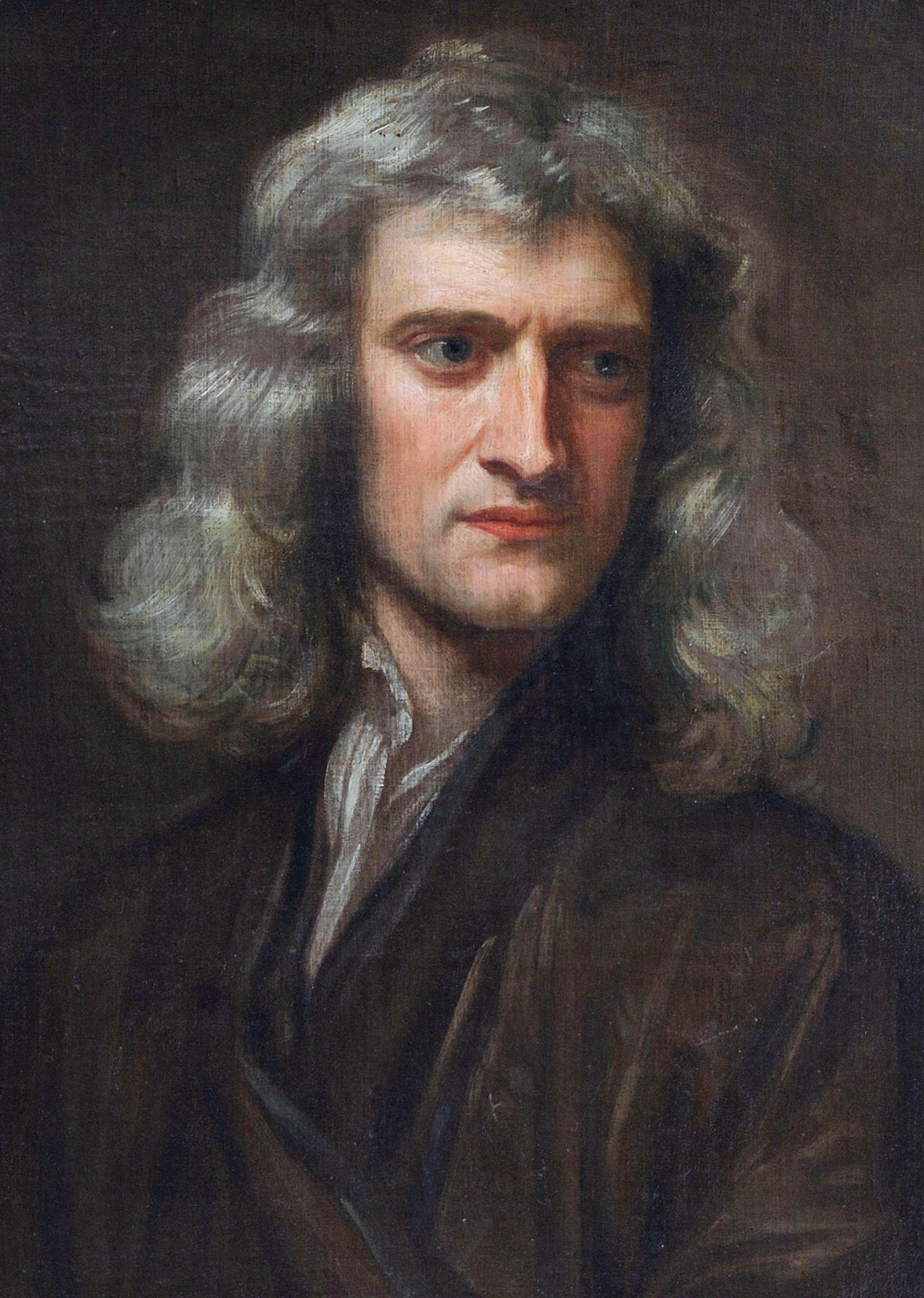
In 1687, in the Principia, Newton wrote down the form of the law of gravity:
\[ F = G\,\frac{M m}{r^2} \]
But how did he arrive at this? Not through a single flash of insight (the apple is a metaphor, not the reasoning). It was a clean mathematical argument: Kepler's laws + Newton's second law + the circular-orbit approximation = the 1/r² law. This article walks through that argument.
The starting point: Kepler's laws (~1609-1619)
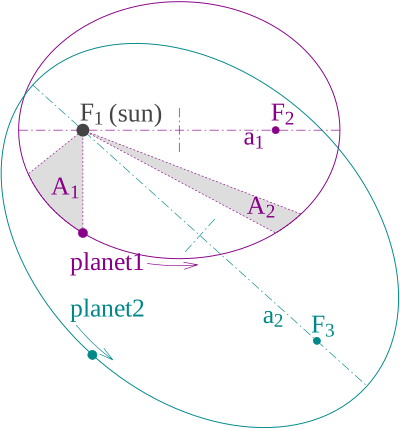
Seventy years before Newton, Kepler had discovered three empirical laws about planetary orbits around the Sun:
- Planetary orbits are ellipses, with the Sun at one focus.
- The line joining a planet to the Sun sweeps equal areas in equal times. (Planets move faster when near the Sun.)
- The square of the orbital period is proportional to the cube of the semi-major axis:
\[ T^2 = k\, a^3 \]
with the same
kfor every planet in the Solar System. That is a strong hint of a central force acting from the Sun.
The third law was Newton's key input. Let's see why.
Simplification: circular orbits
Most planetary orbits (except Mercury and Mars) are nearly circular — eccentricity is small. For Earth, e ≈ 0.017 — very nearly a circle. Take a circular orbit of radius r; the elliptical case reduces to the same result (with a in place of r).
In a circular orbit at constant speed v, the orbital circumference is 2πr and the period is T:
\[ v = \frac{2\pi r}{T} \]
The planet has centripetal acceleration toward the center (the Sun):
\[ a_c = \frac{v^2}{r} = \frac{(2\pi r/T)^2}{r} = \frac{4\pi^2 r}{T^2} \]
Combining Kepler's third law with centripetal acceleration
Kepler's third law: T² = k·r³. Substitute into the acceleration:
\[ a_c = \frac{4\pi^2 r}{k\, r^3} = \frac{4\pi^2}{k}\cdot \frac{1}{r^2} \]
The pillar result:
\[ \boxed{a_c \propto \frac{1}{r^2}} \]
A planet's acceleration toward the Sun falls off as the inverse square of the distance. That is the 1/r² law — and we have not yet even mentioned "force"; we derived it from the geometry of orbits and Kepler alone.
Bringing in "force": Newton's second law
By F = ma, if the planet has mass m and undergoes centripetal acceleration a_c, then the force from the Sun on the planet:
\[ F = m a_c \propto \frac{m}{r^2} \]
So the Sun's gravitational pull on a planet of mass m at distance r is proportional to m/r².
Why M (the Sun's mass) also appears
The above only put m (the planet's mass) into the force. Where does the M in GMm/r² come from?
Newton's elegant answer — his third law (action–reaction):
- The Sun pulls the planet with
F = GMm/r². - By Newton's third law, the planet pulls the Sun with the same magnitude of force.
- But if we replay the argument from the Sun's perspective (the Sun being pulled by the planet), the force must be proportional to
M(the mass of the object being pulled — i.e., the Sun).
Both must be true simultaneously:
F ∝ m/r²(Sun acting on planet)F ∝ M/r²(planet acting on Sun)
The only way: F ∝ Mm/r². Both masses appear, symmetrically. A proportionality constant is needed — Newton called it G:
\[ F = G\,\frac{Mm}{r^2} \]
But Newton did not have G
Notice that nowhere in the above did we compute the number G. Kepler gave the constant k; centripetal acceleration is 4π²r/T²; but the ratio only fixed the form of the law, not its magnitude.
Newton died 71 years before Cavendish. In Newton's era, the number G was unknown — and therefore the absolute mass of the Sun or Earth was unknown. Only ratios were accessible (M_Sun/M_Earth ≈ 330,000).
If you combine Kepler's law with a_c = 4π²r/T², you can compute the product GM_Sun (called the standard gravitational parameter of the Sun):
\[ G M_\odot = 4\pi^2 r^3 / T^2 \approx 1.33 \times 10^{20}\ \mathrm{m^3/s^2} \]
But you cannot pull G and M_Sun apart. To separate them, one must measure G independently — a task Cavendish completed a century later (Article 2).
"The Moon test": Newton's crowning check
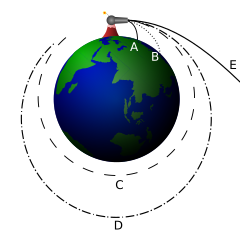
At this point, Newton had a personal challenge: is this "central force" that holds planets around the Sun the same gravity that pulls an apple? If yes, then we have a universal law.
Newton's argument:
If the 1/r² law is correct, the gravitational acceleration on an object at distance r from Earth's center is proportional to 1/r². So if an apple at Earth's surface feels g, the Moon at distance r_moon should feel a much smaller acceleration:
\[ \frac{a_\text{moon}}{g} = \frac{R_E^2}{r_\text{moon}^2} \]
Numbers available to Newton:
g ≈ 9.8 m/s²(from Galileo — see his method)R_E ≈ 6.37 × 10⁶ m(from Eratosthenes and later refinements)r_moon ≈ 3.84 × 10⁸ m(from astronomical parallax)T_moon ≈ 27.3 days ≈ 2.36 × 10⁶ s(from observation)
Prediction from the 1/r² law:
\[ \frac{r_\text{moon}}{R_E} \approx 60.3 \]
\[ a_\text{moon}^\text{predicted} = \frac{g}{60.3^2} \approx \frac{9.8}{3636} \approx 2.70 \times 10^{-3}\ \mathrm{m/s^2} \]
Direct measurement from the Moon's orbit (assumed circular):
\[ a_\text{moon}^\text{measured} = \frac{4\pi^2\, r_\text{moon}}{T_\text{moon}^2} = \frac{4\pi^2 \cdot 3.84 \times 10^8}{(2.36 \times 10^6)^2} \approx 2.72 \times 10^{-3}\ \mathrm{m/s^2} \]
They match! Predicted 2.70, measured 2.72 — less than 1% discrepancy. This is the moment: the same force that pulls the apple holds the Moon in orbit. Gravity is a universal law.
Newton himself said he first saw this in 1666, when he was 23 — but he waited 20 years to publish, both to complete the mathematics and to secure a better measurement of R_E.
What you should be able to do
After this article, you should be able to:
- Combine Kepler's third law (
T² ∝ r³) with centripetal acceleration (4π²r/T²) to derivea ∝ 1/r² - Explain why in
F = G·Mm/r², both masses appear — not just one (from Newton's third law) - Distinguish between "the form of the law" (Newton) and "the constant G" (Cavendish)
- State why
M_Ewas unknown until 1798 - Reproduce the Moon test with numbers — a
1/r²prediction vs. direct measurement
Preview of Article 2
Now that we have the law but not the number G, the only way forward is to measure it directly in the laboratory: compute the gravitational force between two known masses. The problem: this force is tiny — for two 1-kg spheres 1 m apart, about 10⁻¹⁰ N. How do you measure a force this weak in the presence of friction, air currents, and vibrations from the ground?
Cavendish's answer: the torsion balance — a beautifully creative design we'll see in Article 2.
📚 Primary source: Isaac Newton, Philosophiæ Naturalis Principia Mathematica, 1687 — Book III, Propositions 1-8. 📖 Open reference: OpenStax University Physics Vol 1 — §13.1: Newton's Law of Universal Gravitation. 📖 Feynman Lectures Vol I — Ch 7: The Theory of Gravitation (§7-4 is a beautiful telling of the Moon test).
Have a question? 🤔
If something isn't clear or you have a question, ask it here. The answer will be published on this page.