1. Invent yourself: Pinhole sunglasses

Problem Description & Analysis
Official Problem Statement
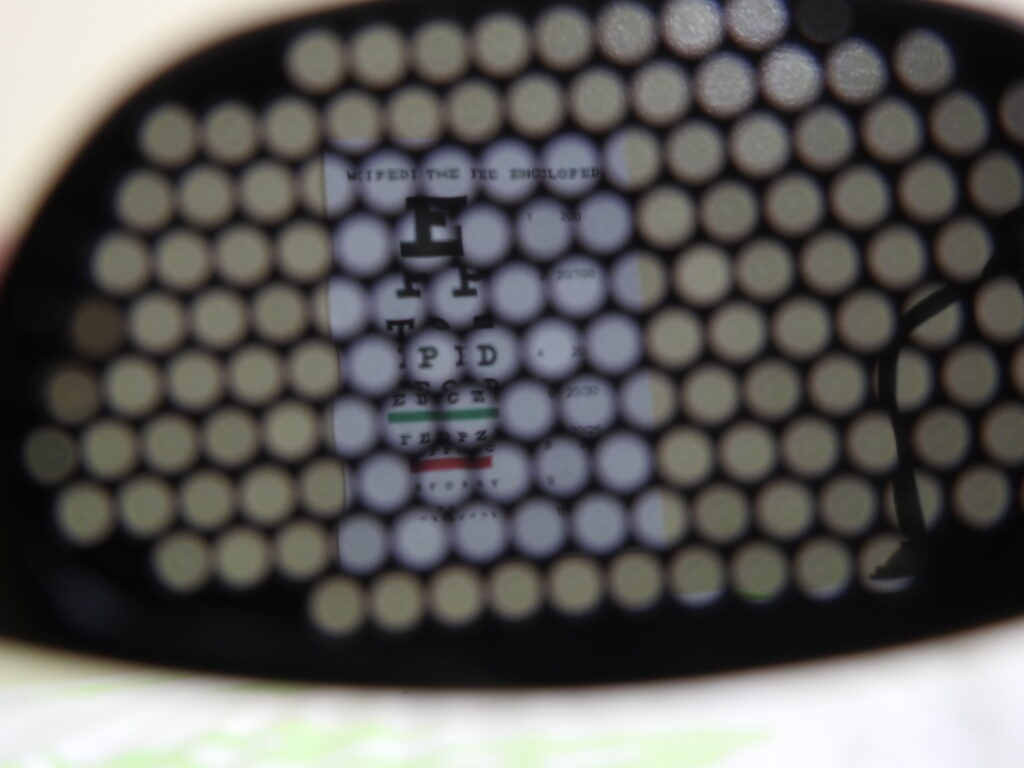
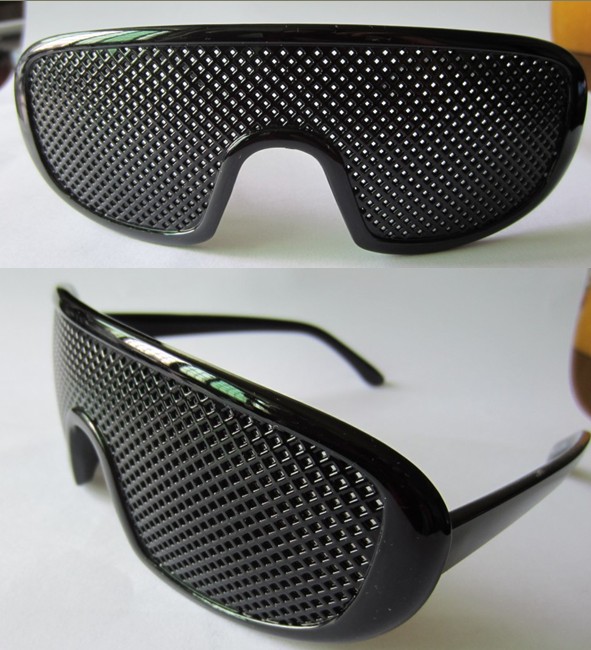
Investigate the optimal arrangement of pinholes in an opaque film to produce sunglasses that reduce light intensity and help correct short-sightedness.
Key Physics Concepts
Geometric Optics — Depth of Field
Each pinhole acts as a tiny aperture stop. As the hole diameter decreases, the cone of light passing through narrows, reducing the circle of confusion on the retina — allowing even myopic or hyperopic eyes to see a relatively sharper image.
dblur = D × |1/f − 1/v − 1/u|
dblur : diameter of the blur (circle of confusion) on the retina — in metres (m)D : pinhole diameter — in metres (m)f : focal length of the eye’s lens — in metres (m) ≈ 0.017 mv : image distance (lens to retina) — in metres (m) ≈ 0.017 mu : object distance (object to lens) — in metres (m)
As D decreases, the blur circle shrinks and depth of field increases.
Wave Optics — Diffraction
Reducing the aperture too much introduces a wave-optics limit: when D approaches the wavelength of light, diffraction dominates and the Airy pattern blurs the image. Rayleigh’s resolution limit:
θmin = 1.22 × λ / D
θmin : minimum resolvable angle (Rayleigh criterion) — in radians (rad)λ : wavelength of light — in metres (m); green light: λ ≈ 550 nm = 550×10⁻⁹ mD : pinhole diameter — in metres (m)1.22 : Rayleigh constant (dimensionless, from Bessel function zero)
Conclusion: there is an optimal diameter that balances geometric blur (large D) and diffraction blur (small D).
Optimal Pinhole Diameter
At the point where geometric blur equals diffraction blur, the total blur is minimised. For image distance v (approximately the focal length of the eye, ≈ 17 mm) and green light (λ ≈ 550 nm):
Dopt ≈ √(2.44 × λ × v) ≈ 0.15 mm
Dopt : optimal pinhole diameter — in metres (m)λ : wavelength of light — in metres (m); green light: λ ≈ 550 nm = 550×10⁻⁹ mv : retinal distance from lens — in metres (m); v ≈ 17 mm = 0.017 m2.44 : Rayleigh diffraction constant (= 2 × 1.22) — dimensionless
This value matches commercially available pinhole glasses (0.1–0.3 mm holes).
Parameters to Investigate
- Hole diameter D — directly controls depth of field and diffraction intensity
- Hole spacing (pitch) — if too close, diffraction patterns from adjacent holes interfere
- Arrangement pattern — square lattice vs. hexagonal lattice
- Film thickness — thicker film = smaller acceptance angle = narrower field of view
- Hole density — more holes = brighter image but higher interference risk
Suggested Experimental Procedure
- Fabricate several samples with different diameters (0.1–0.5 mm)
- Measure visual acuity for each sample using a Snellen chart
- Measure transmitted light intensity with a lux meter
- Determine the useful field of view by gradually rotating the glasses
- Compare results with the theoretical model above
Related Images
Interactive Simulation (Python)
This simulation runs directly in your browser — no Python installation needed. Initial loading may take a few seconds.
(b) Light transmission (%) vs. hole diameter — shows the quadratic dependence of transmitted intensity on the D/pitch ratio.
(c) Comparison of diffraction, geometric, and total blur values (in µm) — displayed for the user-selected diameter.
Python Code Lab
Edit this starter code, enter your own experimental data, and run it directly in the browser — no Python installation required.
Suggested Resources
Have a question or want to learn more?
✉ Ask a Question