
4. Singing capacitor
Problem Description & Analysis
Official Problem Statement
Certain types of ceramic capacitors emit an audible sound when an alternating voltage is applied across them. Investigate the characteristics of the sound produced and how they depend on relevant parameters, such as voltage, frequency, and capacitor properties.
Certain types of ceramic capacitors emit an audible sound when an alternating voltage is applied across them. Investigate the characteristics of the sound produced and how they depend on relevant parameters, such as voltage, frequency, and capacitor properties.
Everyday Example: The Charger Hum
Hold your ear close to a phone charger, laptop adapter, or PC power supply. Do you hear a faint whine or high-pitched hum? That sound comes from ceramic capacitors on the circuit board inside — exactly the “singing capacitor” phenomenon. It is hidden in the background of everyday electronics, and once you know what to listen for, you will hear it everywhere.
Suggested Experimental Procedure
Signal Generation
Two low-cost methods for producing a variable-frequency AC signal:
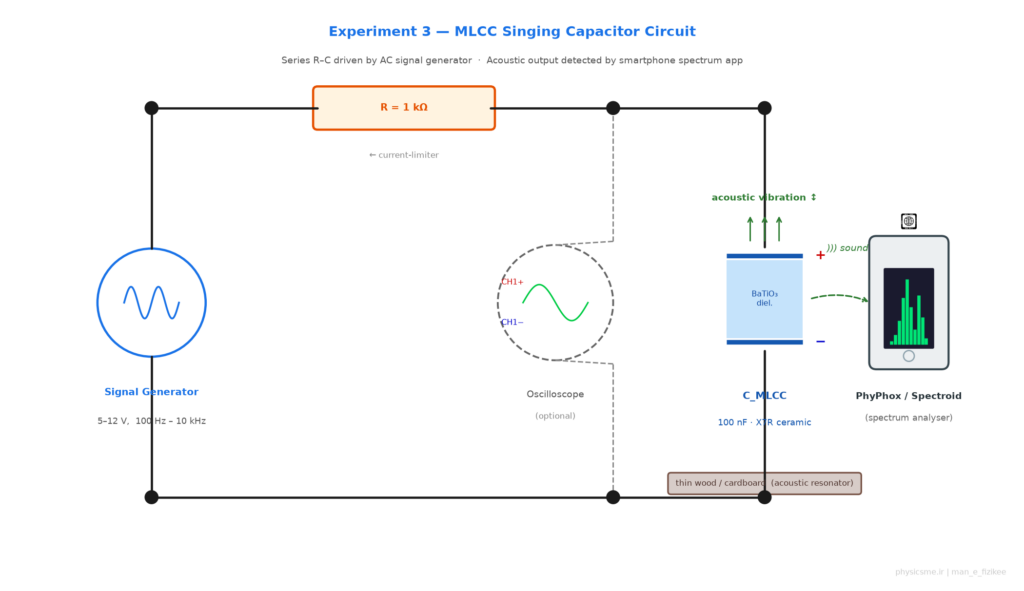
- Computer software: Use Audacity (free), an online Tone Generator, or a Signal Generator smartphone app. Connect the device audio output directly to the MLCC capacitor.
- 555 timer oscillator circuit: Build an astable NE555 circuit (costs less than a dollar). By changing resistors R₁, R₂ and capacitor C, the output frequency spans from a few Hz to several kHz.
Main Experiment
- Connect an MLCC capacitor (e.g., 100 nF or 1 μF) to the signal source.
- Slowly sweep the frequency from 50 Hz to 5 kHz.
- Use a smartphone microphone with Spectroid or FFT Spectrum Analyzer to record the acoustic spectrum.
- Compare the frequency of the emitted sound with the driving electrical frequency — is it f or 2f?
- Vary the voltage and find the relationship between sound intensity and voltage.
Component Comparison
- Compare MLCC capacitors of different capacitances (100 nF, 1 μF, 10 μF).
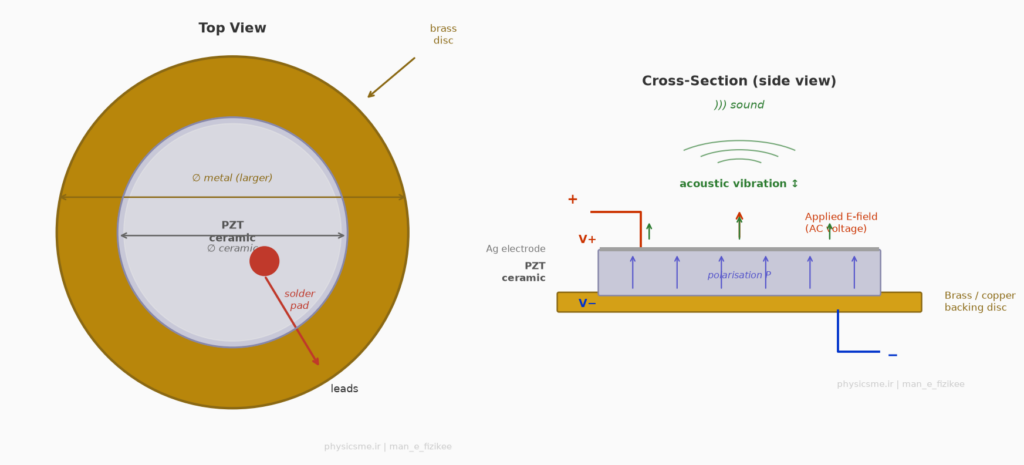
- Test different piezoelectric buzzers — is the emitted sound louder?
- Monitor capacitor temperature during the experiment — it warms up at the resonance frequency.
Related Images
Suggested Resources
Questions & Discussion
You must be an IYPT member and logged in to view or ask questions.
Log In