
Problem 3 IYPT 2027

3. Snail Ball

Fluid Dynamics Mechanics

Problem Description & Analysis

Official Problem Statement

A hollow sphere contains a heavy ball and some viscous fluid. The rolling motion of such a sphere down an inclined plane is uneven and surprisingly slow. Explain and investigate this effect.

Everyday Example: Raw Egg vs Hard-Boiled Egg

You can observe this phenomenon with a simple kitchen experiment: place a raw egg and a hard-boiled egg on a slope and release them. The hard-boiled egg (solid interior) rolls faster; the raw egg (liquid interior) rolls slower and more unevenly — exactly the snail-ball effect. The physics is identical: the liquid inside acts as a damped pendulum that alternately absorbs and releases energy.

Key Physics Concepts

System Structure

Consider a hollow sphere (mass M, radius R) containing a heavy solid ball (mass m, radius r) and viscous fluid:

  • The inner ball rests at distance d = R − r from the sphere centre
  • The viscous fluid provides a damping coupling (coefficient b [N·m·s/rad])
  • When the sphere rolls, the inner ball oscillates like a spherical pendulum

Why Is the Motion Uneven?

Natural frequency of the inner pendulum:

ωp = √(g·cosα / (R − r))

  • ωp: natural angular frequency of the inner ball pendulum [rad/s]
  • g: gravitational acceleration [m/s²]
  • α: inclination angle [rad]
  • d = R − r: effective pendulum length [m]

The sphere’s acceleration creates a pseudo-force in the sphere’s reference frame, displacing the inner ball and setting it oscillating. This alternately slows and speeds the sphere — producing uneven motion.

Why Is It Surprisingly Slow?

Lagrangian equations of motion (coupled two-degree-of-freedom system):

(Mtot + Is/R²)·s̈ + m·d·cos(α+φ)·φ̈ = Mtot·g·sinα + m·d·φ̇²·sin(α+φ)
m·d²·φ̈ + m·d·cos(α+φ)·s̈ = −m·g·d·sinφ − b·φ̇

  • s: sphere displacement along incline [m]
  • φ: inner ball angle from vertical [rad]
  • Mtot = M + m: total system mass [kg]
  • Is = (2/3)·M·R²: moment of inertia of thin spherical shell [kg·m²]
  • d = R − r: effective pendulum length [m]
  • b: viscous damping coefficient [N·m·s/rad]
  • dot (·) and double-dot (̈): first and second time derivatives

The inner ball increases the system’s effective rotational inertia; the viscous fluid dissipates oscillation energy — result: surprisingly slow rolling.

Comparison with Reference Cases

  • Solid sphere (same total mass): a = 5/7 · g sinα ≈ 0.714 g sinα
  • Plain hollow sphere (shell only): a = 3/5 · g sinα = 0.600 g sinα
  • Snail ball: slower than the plain hollow sphere
  • Raw egg: the kitchen equivalent — slower than a hard-boiled egg for the same reason

Parameters to Investigate

  • Inclination angle α: affects both acceleration and pendulum frequency
  • Inner ball mass m: heavier → stronger slowing effect
  • Fluid viscosity η: higher viscosity → smoother but still slow rolling
  • Radii R and r: set effective pendulum length d = R−r
  • Surface friction: rolling friction affects measured acceleration

Suggested Experimental Method

  1. Use a transparent hollow sphere (or a raw egg) to observe the inner ball motion
  2. Fill with different amounts of glycerol to vary viscosity
  3. Vary inclination from 5° to 30°
  4. Time the sphere over a fixed distance (e.g. 50 cm); repeat several times and average
  5. Compare with an empty hollow sphere of the same radius (reference)
  6. Film from the side to capture the uneven oscillatory motion

Resources

Phenomenon Animation

Snail ball animation
Left: hollow sphere on a 15° incline; inner ball (orange) oscillating as a pendulum.
Right: instantaneous velocity of snail ball (blue) vs plain hollow sphere (yellow) and solid sphere (green).
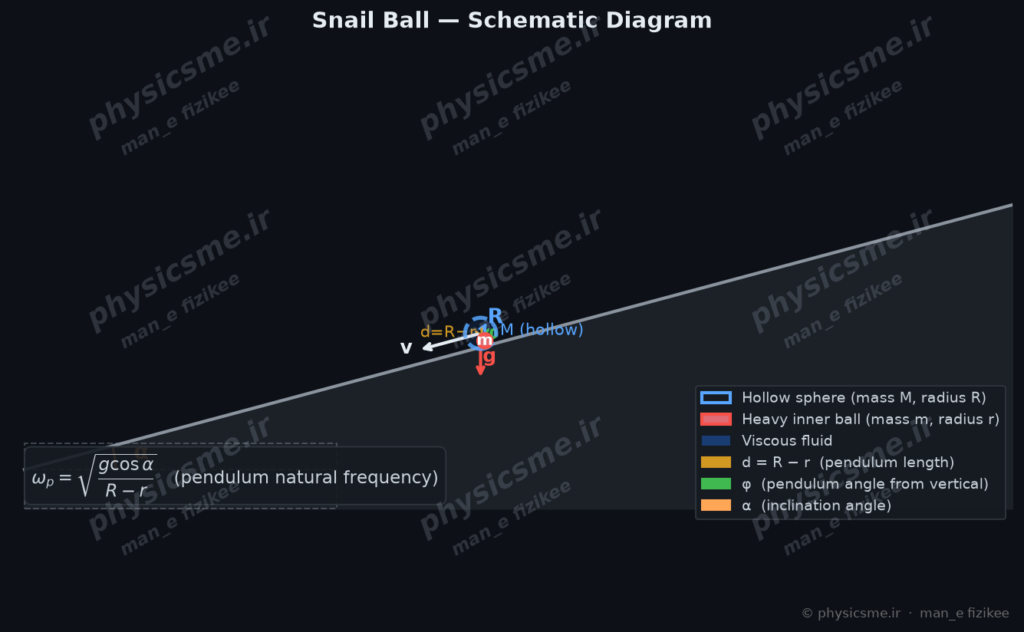
Snail ball schematic
Schematic: hollow sphere (M, R), inner ball (m, r), pendulum length d = R − r, pendulum angle φ, inclination α.

Interactive Simulation (Python)

This simulation runs directly in your browser — no Python installation needed. Initial loading may take a few seconds.

Press the button below to start.
(a) Sphere position along the incline vs time: snail ball (blue) rolls slower than the plain hollow sphere (yellow) and solid sphere (green) — extra inertia from the inner ball + viscous damping.
(b) Instantaneous velocity: small oscillations reveal the "uneven" motion — the inner ball acts as a pendulum with ωp = √(g cosα/(R−r)).
(c) Inner ball pendulum angle φ(t): damped oscillations due to viscous fluid; vertical dotted lines mark each half-period.

Python Code Lab

Edit this starter code, enter your own experimental data, and run it directly in the browser — no Python installation required.

 Python — Editable
Ready to run
Output

Suggested Resources

Have a question or want to learn more?

✉ Ask a Question