
7. Sinking funnel
Problem Description & Analysis
7. Sinking Funnel
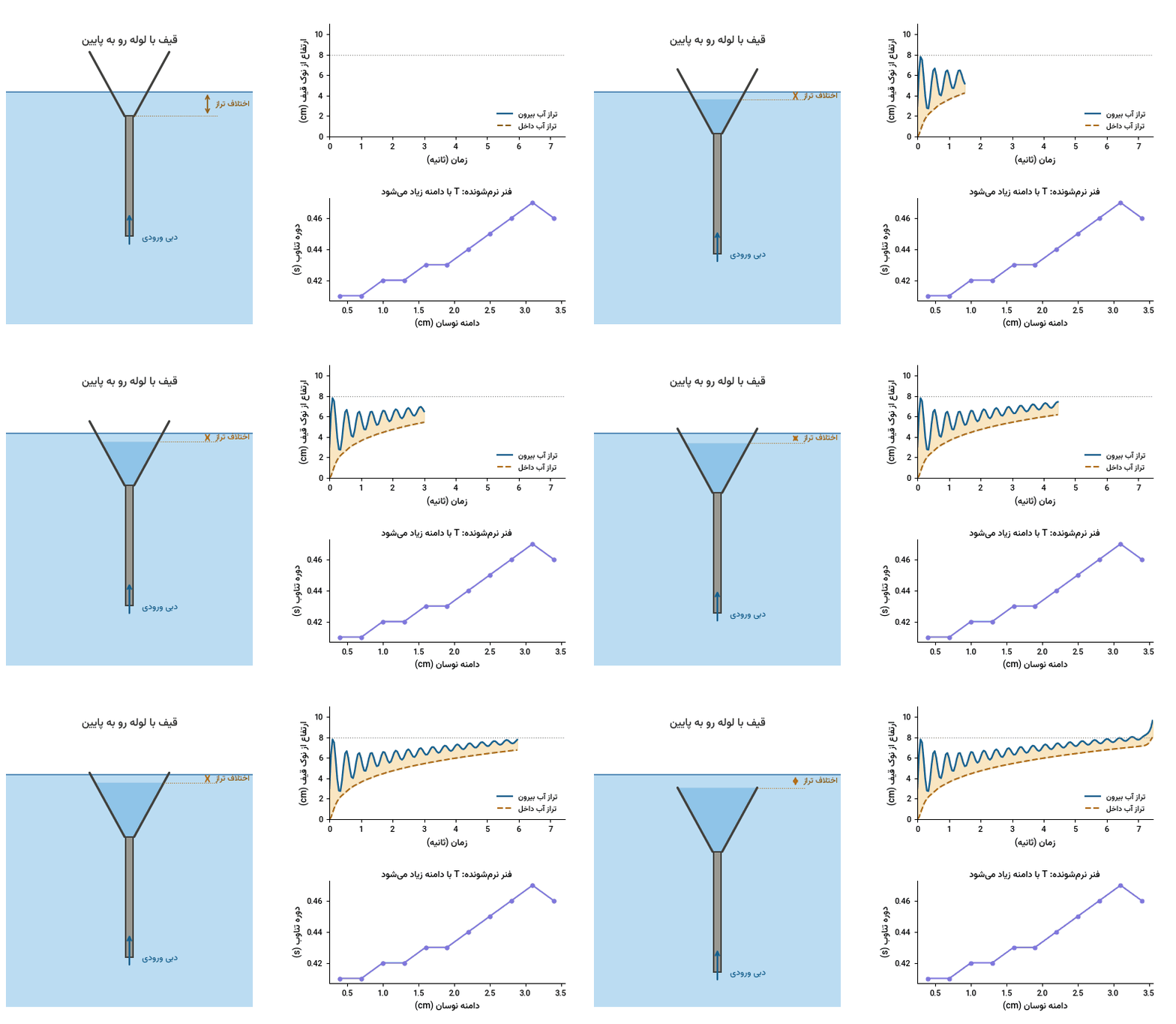
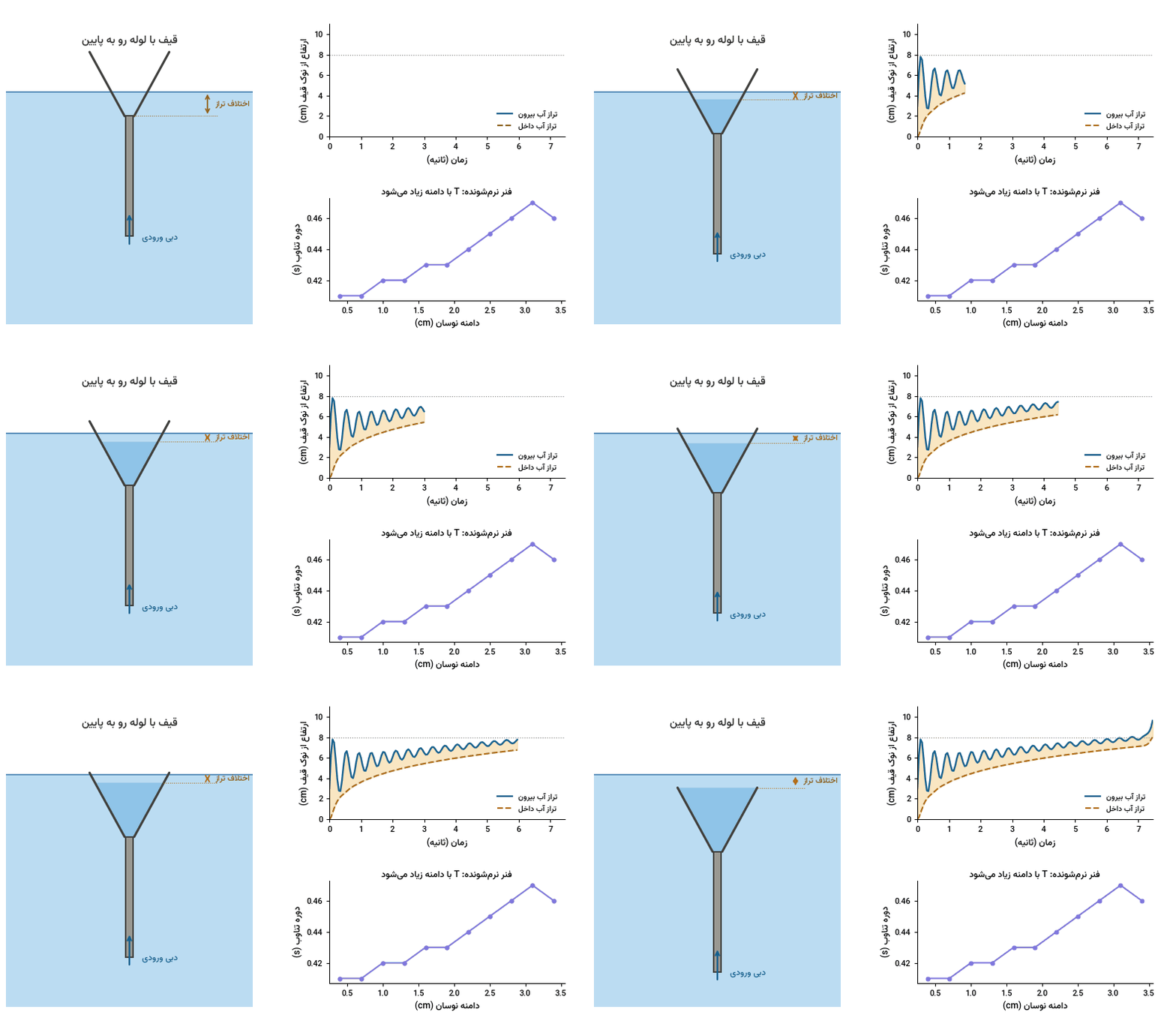
When a long-stemmed and sufficiently heavy funnel is released vertically into water with the stem pointing downward, it undergoes a series of damped vertical oscillations while gradually sinking. Investigate the motion and stability of the sinking funnel and the conditions under which the funnel tips over.
Place a plastic funnel open-end down on a water surface — air is trapped inside. As the trapped air compresses (Boyle’s law), the funnel gradually sinks. What controls the rate and dynamics of descent?
Funnel Geometry
- Base radius R, half-angle θ, cone height H = R/tan θ
- Cone volume: V_cone = πR²H/3
- Stem radius r_s, length L_s → V_stem = πr_s²L_s
- Initial trapped air volume: V₀ ≈ V_cone
Physics: Boyle’s Law + Equation of Motion
Let z be the depth of the air pocket below the water surface. Boyle’s law (isothermal) gives:
V_air(z) = P₀ · V₀ / (P₀ + ρ_w · g · z)
Equation of motion (z positive downward):
m · z̈ = (m − ρ_w · [V_funnel + V_air(z)]) · g − ½ C_D ρ_w A v|v|
Two Behavioural Regimes
- Initially floating: If m < ρ_w(V_funnel + V₀), the funnel floats. As depth increases, V_air shrinks until the net force turns downward — a tipping point leading to accelerating descent.
- Immediately sinking: If m > ρ_w(V_funnel + V₀), the funnel sinks at once with increasing acceleration (positive feedback from shrinking V_air).
Two-Phase Analysis: From Stem Entry to Cone Submersion
The funnel’s descent proceeds in two distinct phases that must be treated separately:
• The narrow stem enters the water first
• The wide cone mouth is still above the water surface
• Air can escape freely through the open mouth — H-P is not yet the bottleneck
• The funnel descends quickly in this phase with minimal resistance and gains an initial velocity
• Phase 1 ends when the cone rim crosses the water surface
Ratchet Mechanism — Why Oscillations Drive Gradual Sinking
The problem statement says the funnel undergoes damped vertical oscillations while gradually sinking. These two phenomena are coupled through a ratchet (one-way cycle) mechanism:
- Downstroke (compression): depth $z$ increases → $Delta P = rho_w g z$ larger → $Q = frac{pi r_s^4 Delta P}{8mu L_s}$ larger → more air escapes through the stem per unit time.
- Upstroke (expansion): depth $z$ decreases → $Delta P$ smaller → $Q$ smaller → less air escapes. But the air that left on the downstroke does not return — the water column prevents air re-entry.
- Net per cycle: air lost (downstroke) > air returned (upstroke) = zero. So each oscillation → net decrease in $V_text{ref}$ (air volume at atmospheric pressure).
$$Delta V_text{ref,cycle} = -int_0^T Q(z(t)),dt < 0 quadtext{(one-way)}$$
The chain of consequences:
→ smaller $V_text{air}(z)$ at every depth
→ lower buoyancy force $rho_w g V_text{air}$
→ new equilibrium at a greater depth $z_text{eq}’ > z_text{eq}$
→ funnel settles slightly lower after each oscillation
→ gradual sinking
Boyle’s law positive feedback on every downstroke
In addition to the long-term ratchet, every downstroke contains an instantaneous positive feedback loop:
→ water pressure increases on trapped air
→ air compresses (Boyle’s law) → smaller volume
→ buoyancy decreases
→ net downward force increases
→ funnel accelerates downward
→ positive feedback (downward-unstable loop)
This positive feedback means the depth equilibrium is unstable: the funnel oscillates as long as the initial buoyancy ($m < rho_w(V_f + V_0)$) permits. As the ratchet drains the air, this buoyancy is lost and the funnel transitions to monotonic sinking.
Oscillation amplitude also decreases because the restoring buoyancy force weakens as air escapes — this is the “damping” of the oscillations.
Air Escape Through Stem (Advanced Model)
If air escapes via Hagen–Poiseuille flow through the stem:
dV_air/dt = −(π r_s⁴ / 8μ L_s) · ΔP(z)
where ΔP(z) = ρ_w·g·z is the overpressure and μ is air viscosity. A narrower stem → slower air escape → slower, more controlled descent.
Terminal Velocity
At large depths V_air → 0, so:
v_terminal = √(2(m − ρ_w V_funnel)g / C_D ρ_w A)
Advanced Analysis: Volumetric Flow Rate and Reynolds Number
Volumetric Flow Rate Q
The Hagen–Poiseuille law gives the volumetric flow rate of air escaping through the stem:
$$Q(z) = frac{pi r_s^4}{8,mu_{mathrm{air}},L_s},Delta P = frac{pi r_s^4,rho_w g}{8,mu_{mathrm{air}},L_s},z$$
• Q(z) = volumetric air flow rate [m³/s]
• rs = inner stem radius [m] — the dominant parameter: Q ∝ rs⁴
• μair = dynamic viscosity of air ≈ 1.8×10⁻⁵ Pa·s
• Ls = stem length [m]
• ΔP = ρwgz = gauge pressure of trapped air [Pa]
Fourth-power law: doubling the stem radius → 16× the flow rate → 16× faster sinking.
Q ≈ 15 cm³/s → with V₀=100 cm³ the funnel sinks in ≈7 s
Reynolds Number — Validating the Laminar-Flow Assumption
Hagen–Poiseuille is valid only for Re < 2300 (laminar flow). The mean air velocity and Reynolds number in the stem are:
$$v_{mathrm{avg}} = frac{Q}{pi r_s^2} = frac{r_s^2,rho_w g z}{8,mu_{mathrm{air}},L_s}$$
$$mathrm{Re} = frac{rho_{mathrm{air}},v_{mathrm{avg}},(2r_s)}{mu_{mathrm{air}}} = frac{rho_{mathrm{air}},r_s^3,rho_w g z}{4,mu_{mathrm{air}}^2,L_s}$$
rs=1 mm → Re ≈ 225 ← laminar H–P valid
rs=3 mm → Re ≈ 6000 ← turbulent H–P breaks down
For stems with rs > 2 mm the flow may become turbulent. Testing whether the tsink ∝ rs⁻⁴ scaling still holds in that regime is one of the interesting experimental questions.
Experimental Setup
1. Basic Apparatus
- Glass aquarium 30×20×20 cm with depth marks every 1 cm on the side wall
- Plastic lab funnels — several sizes for systematic comparison
2. Controlling Stem Radius rs
- Nail varnish: several coats inside the stem — each coat reduces rs by ~0.1 mm
- Wax: melt paraffin into stem, then bore a central hole with a heated wire
- Metal wire: insert a wire of known diameter, seal with silicone around it
- 3-D printing: print funnel with precise rs (±0.1 mm) — best control
3. Preventing Tip-Over ️
During descent the buoyancy force acts at the centre of buoyancy (top of the cone) while gravity acts at the centre of mass (lower). This couple tends to capsize the funnel:
- Guide rail (recommended): a vertical rod from tank bottom to top + a sliding ring on the funnel — prevents rotation without significant friction
- Annular weight: a heavy ring clipped to the funnel rim — lowers the centre of mass and makes the funnel self-righting
4. Measurements
- Camera at 120 fps + Tracker (free) to extract position from video frames
- Direct flow measurement: a U-tube manometer attached to the stem outlet tracks Vair(t) directly
- Pressure sensor (advanced): MPX5010DP + Arduino inside the funnel
5. Controlled Experiment Design
- Independent variable: rs — change only this, keep everything else fixed
- Five repetitions per condition → mean ± standard deviation
- Plot tsink vs 1/rs⁴ — should be linear through the origin if H–P holds
- Log–log plot of tsink vs rs — slope should be ≈ −4 in the laminar regime
Interactive Python Simulation — Sinking Funnel Dynamics
This simulation numerically solves the sinking-funnel ODE system in three state variables: depth $z$, velocity $v$, and reference air volume $V_text{ref}$ (volume at atmospheric pressure).
- Panel 1: Depth z increases — much faster with a wider stem.
- Panel 2: Trapped air decreases; deeper → faster loss (positive feedback).
- Panel 3: Velocity rises at first, then levels off as buoyancy drops toward the funnel weight.
- The output table shows that for rs > 2 mm the Reynolds number exceeds 2300, violating the laminar-flow assumption.
References
- Denny, M. W. (1993). Air and Water. Princeton University Press. — buoyancy and air-compression dynamics.
- White, F. M. (2015). Fluid Mechanics, 8th ed. McGraw-Hill. — Hagen–Poiseuille derivation and laminar-to-turbulent transition.
- Munson, B. R. et al. (2012). Fundamentals of Fluid Mechanics, 7th ed. Wiley. — drag coefficients for bluff bodies.
Technical Glossary
| Term | Persian equivalent | Definition |
|---|---|---|
| Hagen–Poiseuille (H-P) | قانون هاگن-پوازوی | Laminar-flow rate in a narrow tube: $Q = pi r^4 Delta P / (8mu L)$; extremely sensitive to radius ($r^4$) |
| Buoyancy | شناوری | Upward force exerted by a fluid on a submerged body: $F_b = rho_w g V_text{displaced}$ |
| Boyle’s law | قانون بویل | At constant temperature: $P_1 V_1 = P_2 V_2$; greater depth compresses trapped air, reducing volume |
| Ratchet mechanism | مکانیزم رچت | One-way cycle: each oscillation loses air on the downstroke but recovers none on the upstroke → net sinking |
| Added mass | جرم افزوده | Effective extra mass from accelerating the surrounding fluid; for the funnel ≈ $0.5rho_w V$ |
| Viscosity | ویسکوزیته | Fluid resistance to flow (the $mu$ term in H-P); air: $mu approx 1.8 times 10^{-5}$ Pa·s |
| Positive feedback (Boyle) | بازخورد مثبت (بویل) | Deeper → compressed air → less buoyancy → more downward force → deeper (unstable loop) |
Related Images
Questions & Discussion
You must be an IYPT member and logged in to view or ask questions.
Log In