
14. Non-Newtonian worms
Problem Description & Analysis
14. Non-Newtonian Worms
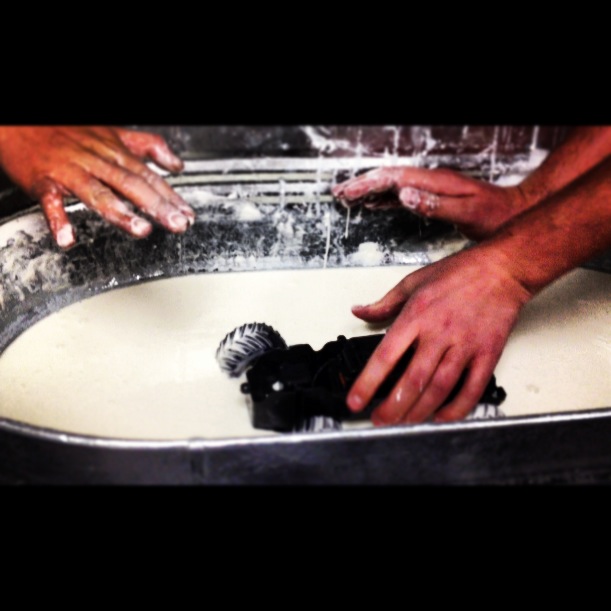
A dilatant non-Newtonian fluid (e.g. a suspension of water and cornflour) is vibrated vertically in a reservoir. When certain conditions are met, wormlike structures that rise from the surface may form. Explain and investigate this phenomenon.
A cornstarch–water mixture (oobleck) placed on a vibrating speaker forms self-organizing worm-like structures that crawl, split, and rejoin. This phenomenon arises from the interplay of rheological nonlinearity and Faraday wave instability.
Power-Law Rheology (Ostwald–de Waele Model)
τ = K · γ̇ⁿ
- n < 1: shear-thinning (pseudoplastic) — toothpaste, blood
- n = 1: Newtonian — water, air
- n > 1: shear-thickening (dilatant) — cornstarch suspension
Apparent viscosity: η_app = K · γ̇^(n−1). For oobleck, n ≈ 1.5–2.5 and K ≈ 10–100 Pa·sⁿ.
Faraday Instability Threshold
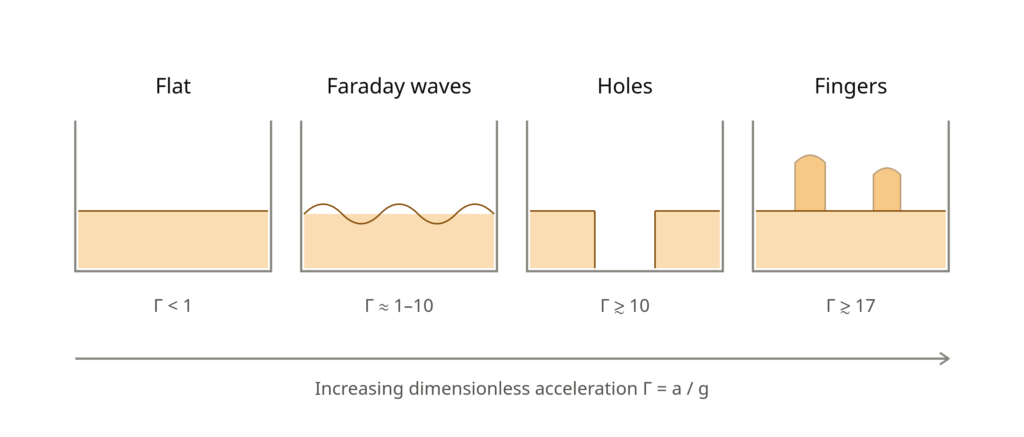
Vertical vibration at amplitude A and frequency f drives subharmonic surface waves at f/2 when the dimensionless acceleration exceeds a critical value:
Γ = A·(2πf)² / g ≥ Γ_c(n, K, h₀, f)
For Newtonian fluids, Γ_c ≈ 1 (independent of viscosity at onset for inviscid limit). For shear-thickening fluids, Γ_c is larger and frequency-dependent.
Thin-Film Equation for Power-Law Fluid
∂h/∂t + ∂/∂x [K̃ · h^(2n+1) · |∂h/∂x|^(n−1) · ∂h/∂x] = f_drive(x,t)
where K̃ = K(2n+1)/(ρ(n+1)) is a nonlinear diffusion coefficient. For n>1, higher h → stronger “anti-diffusion” → fingering instability.
Worm Formation Mechanism
- Faraday instability creates subharmonic surface waves at threshold Γ
- Rheological nonlinearity transfers energy to higher harmonics
- Wave-matter coupling: high-γ̇ regions solidify locally, forming ridges
- Worm structures: narrow solidified columns on a fluidized substrate
References
- Larson, R.G. (1999). The Structure and Rheology of Complex Fluids. Oxford University Press. — Ch. 1: rheology of non-Newtonian fluids; power-law model and shear stress.
- Faraday, M. (1831). “On a peculiar class of acoustical figures.” Phil. Trans. R. Soc. Lond., 121, 299–340. — first description of Faraday waves on a vibrated fluid surface; physical basis of worm formation in vibrated cornstarch.
- Merkt, F.S., Deegan, R.D., Goldman, D.I., Rericha, E.C. & Swinney, H.L. (2004). “Persistent holes in a fluid.” Phys. Rev. Lett., 92, 184501. — persistent holes in vibrated non-Newtonian fluids; directly related to the worm-formation phenomenon.
- Waitukaitis, S.R. & Jaeger, H.M. (2012). “Impact-activated solidification of dense suspensions via dynamic jamming fronts.” Nature, 487, 205–209. — mechanism of instantaneous solidification of cornstarch under impact; explains dilatant behavior.
- Barnes, H.A. (1989). “Shear-thickening (dilatancy) in suspensions of non-aggregating solid particles in Newtonian liquids.” J. Rheol., 33(2), 329–366. — comprehensive review of dilatancy in suspensions; key reference for cornstarch physics.
- Cross, M.C. & Hohenberg, P.C. (1993). “Pattern formation outside of equilibrium.” Rev. Mod. Phys., 65, 851–1112. — general theory of pattern formation in driven systems; theoretical foundation for worm emergence.
Related Articles on physicsme.ir
Related Images
Suggested Resources
- 🔗 Non-Newtonian Fluids — HyperPhysics (GSU)
- 🔗 Rheology — Wikipedia
- ▶ Walking on Oobleck (Non-Newtonian) — SmarterEveryDay
- 🔗 Viscosity & Flow — MIT OCW Fluid Mechanics
- 📖 Merkt, F.S., Deegan, R.D., Goldman, D.I., Rericha, E.C. & Swinney, H.L. (2004). Persistent holes in a fluid. Phys. Rev. Lett. 92, 184501.
- 📖 Deegan, R.D. (2010). Stress hysteresis as the cause of persistent holes in particulate suspensions. Phys. Rev. E 81, 036319.
- 📖 Peterson, J.D. ، A study of dense suspensions climbing against gravity
- 📖 Wyart, M. & Cates, M.E. (2014). Discontinuous shear thickening without inertia in dense non-Brownian suspensions. PRL 112, 098302.
- 📖 von Kann, S., Snoeijer, J.H. & van der Meer, D. (2014). Phase diagram of vertically vibrated dense suspensions. Phys. Fluids 26, 113302.
- 📖 Brown, E. & Jaeger, H.M., Shear thickening in concentrated suspensions: phenomenology, mechanisms, and relations to jamming. Rep. Prog. Phys. (2014).
- 📖 MDPI
Questions & Discussion
You must be an IYPT member and logged in to view or ask questions.
Log In